Separating Edmonton - from the Alberta Status Quo
While the province rolls the constitutional dice, Edmonton must negotiate a stronger future.
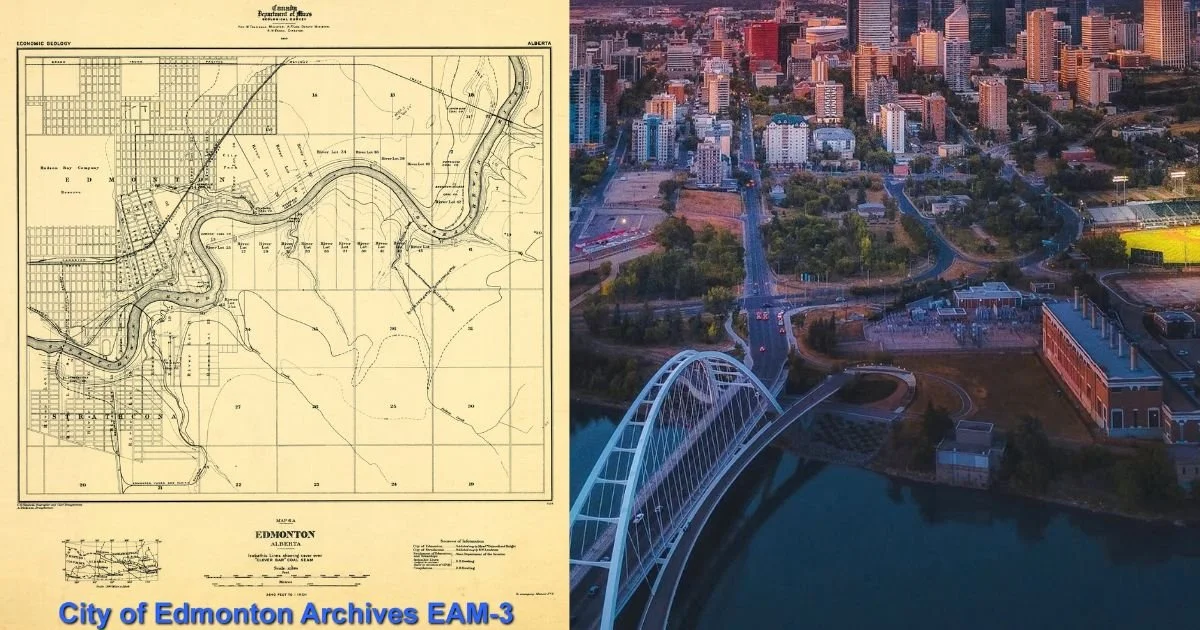
A map of Edmonton from 1910 next to a more recent aerial shot of Edmonton.
On May 27, I made a notice of motion, to be debated in June.
It is driven by one primary concern: fiduciary and social duty to the people of Edmonton.
Edmonton is a $103-billion annual GDP economy but constitutionally, as residents of this city, you are treated like you are a group of children.
The province can cut our funding, override our decisions, set aside agreements we negotiated in good faith, and download costs we never agreed to absorb, and there is nothing, legally, you or I can do about it.
Never has that been more clear than in the controversies surrounding the separatist movement and the announcement of a referendum.
Edmontonians rightly worry how this will affect us financially. How much business are we losing now, and how much more will we lose in the future. We saw these generational losses in Montreal and Quebec City in the 90s, and we are already seeing those consequences happening in Alberta in real time. The Calgary Chamber of Commerce has documented it.
This motion asks for serious leverage, to open new pathways for better provincial partnership, and begin the work of building a more secure, independent, and durable future for our city and all other major municipalities.
Legal scholars have had the same thought.
Kristin Good at Dalhousie University and Alexandra Flynn at UBC (and many more) have both argued that municipalities are democratic governments and should be treated as such.
Instead of going to court, we should be asking, is disallowing a municipality from making decisions undemocratic?
THE MOTION
That Administration prepare and return to Council a report examining options for strengthening Edmonton's constitutional, legislative, and fiscal independence, including but not limited to:
1. Opportunities for stronger direct federal-municipal fiscal arrangements that reduce Edmonton's structural dependence on provincial transfers.
2. The viability and precedents for enhanced city status, including federal territory designation, city-province models, and constitutional entrenchment of municipal standing under Section 43.
3. Options for coordinated advocacy with other major Canadian municipalities toward a new national framework for urban constitutional recognition.
4. Existing and emerging legal pathways toward greater municipal autonomy.
5. An assessment of what a renewed or entrenched City Charter framework would require to be legally durable, in contrast to existing charter arrangements that remain subject to unilateral provincial amendment.
6. The role of Treaty 6 partnerships in strengthening Edmonton's jurisdictional position within the Canadian federation.
The report should identify which pathways are available now, which require federal or provincial cooperation, and which require constitutional change, and recommend a phased strategy for pursuing them.
The power of a motion like this is that it can force a national conversation that is long overdue.
It immediately causes us to clarify the responsibilities of all three orders of government. That alone is worth the price of admission. Role clarity too often falls into frustrating finger pointing and buck passing.
It also asks Council some important questions.
Do we have a duty to stand with our Treaty 6 partners, who have been fighting the constitutional battle against separation largely on their own? Or do we leave them to continue that fight while we watch from the sidelines, and benefit from their perseverance and hard work?
Do we have a duty to protect Edmonton from the kind of investment flight and stalled capital decisions that Montreal experienced after 1995, damage that affects that city's economic trajectory to this day?
Will the province take umbrage at us asking these questions? It shouldn't. This could be a mutually beneficial exploration. And even if it does, is staying quiet and hoping for the best more likely to protect Edmontonians? No. We need to be clear and stand up for our city.
This motion is not asking for a divorce. It is not asking for emancipation. It is asking for a look into how we develop a more productive and sensible partnership – and the ability to compete on a modern global playing field without one leg tied behind our back.
Edmonton is not the only city that needs this conversation, but if this motion passes in Council, we will be the first city willing to officially start it for every municipality.
The constitutional framework governing Canadian cities was written for a fledgling agrarian country. Our big cities are now global players. This motion is the first step toward building something that fits the country we actually are.
That takes time, legal work, political will, and coalition.
Just having this conversation publicly, formally, and on the record, puts the potential of Edmonton's better future on the table. It tells our Treaty partners that we stand with them. It signals to other Canadian cities that the long overdue conversation has begun.
And most importantly, it tells you that your city is not passively accepting whatever comes next.
That we will fight for our better future.
That we are fighting for you.
INFO DUMP
For the nerds, if you would like more details on what this motion would look into, here it is:
Edmonton began as a trading post called Fort Edmonton, built in 1795. It was named after Edmonton, England, which was then a town north of London.
However, in the late 19th century the settlement began to spread outside the fort. Then in 1892, Edmonton was incorporated as a town, and in 1904 it was incorporated as a city.
Edmonton became a city before Alberta became a province in 1905. The same year when Edmonton was chosen as its capital.
Section 92(8) And why it matters.
Under Section 92(8) of the Constitution Act, 1867, cities exist entirely at the pleasure of their provinces. No appeal. No meaningful constitutional protection of any kind.
We saw that with our hard-won 2018 City Charter. It was essentially set aside the following year when Premier Kenney found it inconvenient. Infrastructure transfers can be cut without consultation. Costs the province is constitutionally responsible for can be downloaded onto city budgets with no process and no recourse.
This is not simply a series of bad decisions. It is the system working as designed. And it was designed in 1867 for a country that was mostly farmland and frontier.
Edmonton in 2026 has outgrown that design. All major municipalities have.
1. Direct Federal-Municipal Fiscal Arrangements
Nearly half of Edmonton's capital budget depends on provincial transfers that can be restructured or cut without notice.
Planning a world-class city on that unreliable foundation is a fool's errand.
Houston reduced chronic homelessness by over 60% in a decade because the city controlled its own coordinated funding. Greater Manchester built an integrated regional transit network because it secured a direct long-term transport budget from the national government. Both cities made 20-year decisions because they had 20-year certainty.
We need to partner more fully with the federal government. Both the province and Ottawa need to acknowledge openly what the economy of Alberta and of Canada owes to its big cities.
2. Constitutional Entrenchment via Section 43
Section 43 of the Constitution Act, 1982 allows a constitutional amendment affecting a single province with the consent of Parliament and that province's legislature. Not all ten provinces.
Constitutional scholars and the Canadian Bar Association have identified this as a significant pathway for giving large Canadian cities real and binding constitutional standing. Newfoundland used it for Term 17. Quebec used it for school board reform. The precedent exists.
This requires Alberta's participation, which cannot be forced. But a province-wide petition backed by Edmonton, Calgary, Treaty 6 Nations, and a willing federal government would create political conditions very difficult to refuse publicly.
If Alberta refuses to participate when the invitation is formally and publicly on the record, that refusal is its own story. A province pursuing its own constitutional independence while blocking its capital city from securing constitutional security for its people has a very difficult case to make to Albertans.
3. A National Coalition of Cities
Section 92(8) applies in every province.
In 2018, Ontario cut Toronto's city council in half, mid-election, invoking the notwithstanding clause to override a court that found it unconstitutional. After taking it to the Supreme Court and narrowly losing, Toronto had no avenue to refuse. Vancouver absorbs downloaded social service costs it had no role in creating.
Sound familiar?
The Federation of Canadian Municipalities has documented the municipal fiscal gap for years. A national coalition of major municipalities, representing the majority of Canada's population and economic output, advancing unified demands for constitutional recognition, direct federal fiscal transfers, and a ban on mid-electoral interference, is a coalition governments cannot ignore.
German cities have constitutionally protected self-governance under Article 28 of their Basic Law. French metropolitan authorities have formal standing in national policy negotiations. Canada is the outlier among developed democracies on this.
October 19 provides the political moment to change that. This motion, originating in Edmonton, may provide the opening move.
4. Legal Pathways Toward Greater Autonomy
The scholarship supporting this motion is serious and substantial.
Kristin Good at Dalhousie University has demonstrated the "creatures of the province" doctrine is a legal fiction never properly tested against the Supreme Court's own unwritten constitutional principles of democracy, federalism, and the rule of law. Alexandra Flynn at UBC has argued cities must assert their democratic status in council chambers. A Canadian Bar Association 2022 prize-winning essay establishes Section 43 as a real, precedented, viable pathway for city constitutional entrenchment.
We don't have to invent arguments. They already exist. This scholarship has been waiting for a political actor willing to move.
5. A City Charter That Holds
We already know that City Charters as currently written are not worth the paper they are written on.
Manner and form provisions could change that. A legislated requirement, such as a two-thirds supermajority before a charter can be amended or repealed, would make it a genuinely durable instrument. Alberta can do this without federal involvement and without constitutional amendment. It requires only the political will and integrity to treat Edmonton as a long-term partner.
This is both the minimum condition for a functional relationship between a province and its cities, and the most achievable step on this list.
6. The Treaty 6 Alliance
Edmonton sits entirely on Treaty 6 territory. Our nearest neighbour is Enoch Cree Nation. We have Memoranda of Understanding for mutual benefit with both the Nation and the Confederacy of Treaty No. 6.
Treaties are agreements with the Canadian Crown, specifically the federal Crown. A province cannot remove itself from Canada without severing those Treaty relationships, and that severance is a direct violation of constitutionally protected Indigenous rights under Section 35.
On May 13, 2026, Court of King's Bench Justice Shaina Leonard quashed a previous separatist petition precisely because the Crown had failed its duty to consult First Nations whose Treaty rights would be directly affected. The Confederacy of Treaty No. 6 has already condemned the separation push as an illegal breach of the Treaty relationship.
Edmonton's interests and Treaty 6 Nations' interests are mutually aligned. We are both asking that the constitutional relationship with the Canadian Crown be preserved and we can say so together, formally, in a joint declaration.
I have been reaching out to our Treaty partners on this in conjunction with Council and Administration, and reception has been extremely positive.