
BUDGE IT, BUDGET
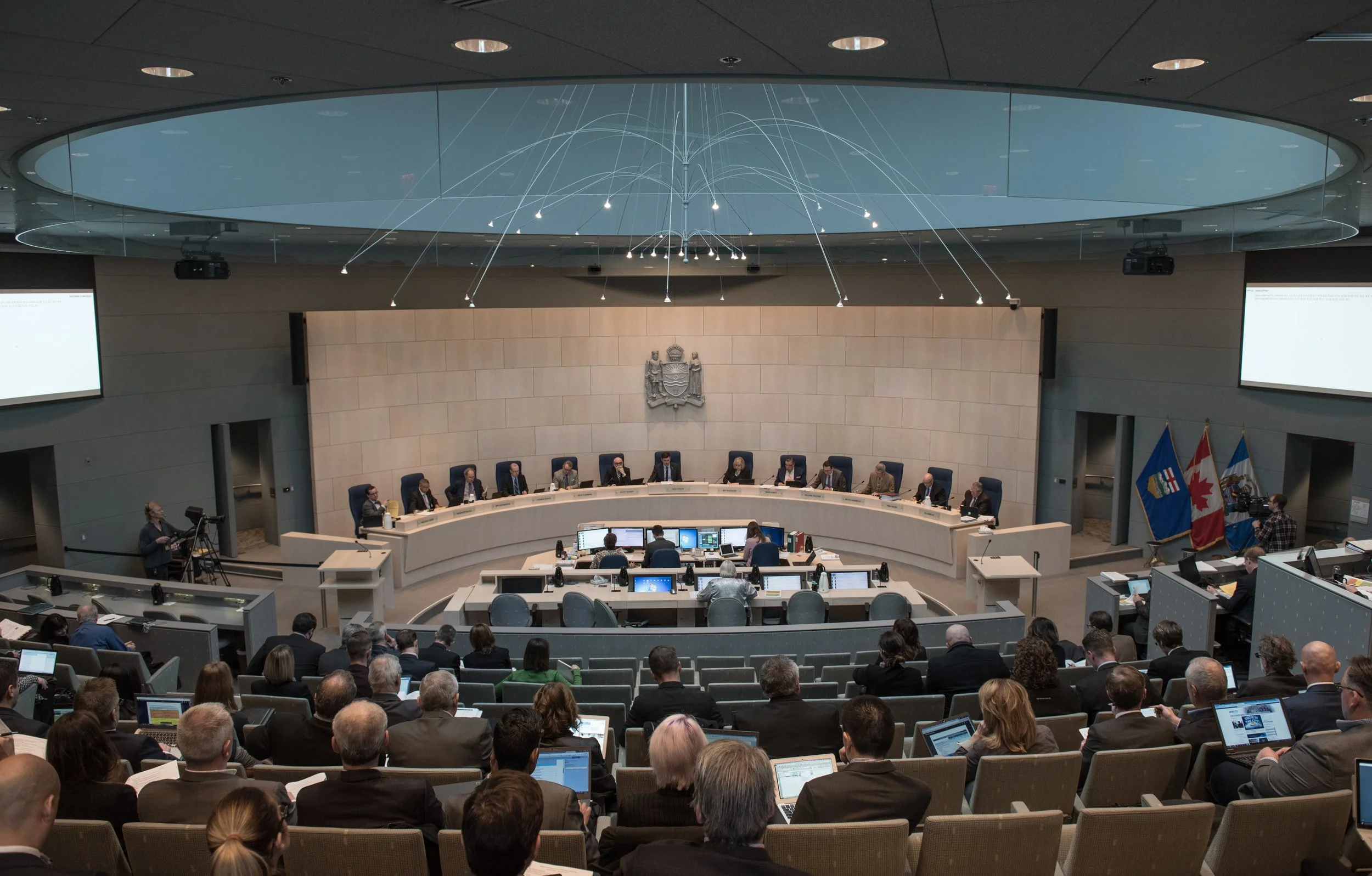
City Hall Chambers
Now that neighbourhoods are finally scheduled for plowing, a quick reminder:
City Council will be going into a 4 year budget in Fall 2026. This will essentially set the service levels for the next 4 years.
Since COVID, to keep taxes from going higher than they have already been, Councils have lowered service levels - or not meaningfully increased them with population growth. There are many reasons for that (pros and cons). We can discuss it another time.
Council and the Mayor will be holding budget roadshows this year so you can have your say. Your say is stronger if you are informed and know the numbers.
“Taxes are too high”
Is a message that is always there.
“Taxes aren’t right because _’opinion’__“ is a little better.
“Taxes should match the service and here is what is an acceptable and sensible level is and here is the data”
… is the STRONGEST voice, especially if it’s something everyone can see and weigh for themselves.
With that in mind, I will be sharing links and reports and creating tools for YOU so that you can have the strongest voice possible.
It’s YOUR city
It’s YOUR money
It’s YOUR policy and service level
If you want it to be easy and say: “just get it done and make it as efficient and as inexpensive as possible” then what I can do is show you what that looks like.
Now, I will also say that it will not be fair to ask every City Councillor to do this at the level I am describing, and for very good reasons:
Besides Mayor Knack, I am the longest current serving Edmonton City Councillor.
I know the files over the last 8 years very well and I have the experience and knowledge to boil all that down in my own unique way - this is one of the ways I am able to serve you to the highest level I possibly can.
But I will be providing information that affects the ENTIRE city so don’t worry, if I am not your Councillor, you will get everything the residents of Ward Dene get.
And I would like to say:
Every City Councillor we have right now all have really remarkable qualities, skills, and smarts. Their hearts and their reasons for serving are all top notch from what I have seen.
You may not LIKE your City Councillor and/or didn’t vote for them, but frankly, I would be saying the same thing about your candidate had they won because it takes a lot to put yourself forward and most folks won’t go through the grind unless they deeply care.
The job is hard and Councillors get a lot of heat - and that is exactly what they signed up for!
But they are also human beings and I have seen the wear and tear from hundreds of toxic interactions.
So, while it is inevitable that Councillors make decisions that we may not personally agree with, that is going to happen to everyone because if a Councillor is around long enough, they will make decisions that anger one group or another over time across a variety of issues but…
They will also make decisions that help almost every single group over time across a variety of issues.
And Council often gets the heat for things literally out of a City Council’s control.
I hope to be able to give you knowledge and information on THAT as well.
But at the end of the day, YOU are the most important source of information.
YOU are the most important voice.
I am looking forward to this discussion.
To start with, you may have seen this, but I made a tool to show you:
- how to make your own snow and ice budget
- gives you a bit of history on past budgets
- shows you comparisons to other cities
etc
It can be absolutely frustrating to be in the dark and wondering why on earth a decision was made. And Councillors often don’t agree either!
Hopefully my efforts will help shed some light on the factors involved with a decision and empower you with information.
Here is the link to the snow and ice budget builder:
aaronpaquette.ca/snow-ice
When you settle on your desired budget, hit the email button under the pie chart there, and send it to me!
And understand that the tax percentage and the budget impact - well, that’s just the reality. Services cost money.
But it can either be “new money” or other services can be reduced to make up the shortfall.
We would just have to talk in the coming months about what we want those other services to look like.
Bonus material and only for those looking for some deeper clarity and information:
___
If you are STILL HERE let’s talk really quickly about another issue that I hear about a lot, and don’t worry, I’ll make a blog/FB post just for this in the future:
The difference between OPERATING dollars and CAPITAL dollars in a budget.
OPERATING is the everyday stuff like labour (employees), and running things. Fuel, Transit, Police, Fire Services, etc
CAPITAL is the big infrastructure costs like a new bridge, a new road, a firehall, etc
OPERATING is paid in full every year. There is no “deficit” the way the federal or provincial governments do it. In 2026, every $22.5m in operating = about 1% in budget growth.
CAPITAL is borrowed (with rates that make the money go further than saving). In 2026, every $100m in capital = about $8m in debt servicing and 0.36% in budget growth.
So the City would need to borrow about $281m to equal 1% in budget growth.
That is a lot of math and words.
Let’s show that simply:
OPERATING: $22.5m = 1%
CAPITAL: $100m = 0.35%
Think of it like a household budget:
OPERATING: Your grocery bill. You pay the full cost at the checkout.
CAPITAL: Your house. You take a loan so you can afford a massive asset now, but pay a smaller monthly amount over 20 years.
Budgets are set in advance every year and City Administration estimates what that will cost for the year.
At the end of the year, there may have been unexpected variations in costs and either there will be a budget deficit (costs were higher than predicted) or a surplus (costs were lower than predicted).
The extra goes into the FINANCIAL STABILIZATION RESERVE (FSR). The deficit gets drawn out of the FSR.
However, in the event of a huge snow like we just had, even the FSR can’t magically buy new plows and trucks or instantly hire new people.
What CAN be done, is contracting out to the private sector to help with the load (which is exactly what has been done this year).
The challenge is even the private sector won’t carry more than they generally need, so there is a limit to what you can hire in for the work.
More just won’t exist!
And wow, deep respect and huge thanks to everyone who has been working overtime since Christmas. Absolutely exhausting work!
Please treat them kindly.
Okay, back to the discussion:
The "Bang for the Buck" Ratio
For the same 1% tax increase:
Spend $22.5 Million on day-to-day operations (Labour, Fuel)
OR
Build $281 Million worth of infrastructure (Bridges, Rec Centres)
Real life example:
Back in 2022 Council approved $100m for a Bike Lane Plan, for example. Now, that’s actually a pretty bad name because it really went primarily to missing sidewalk segments and widening a few sidewalks.
Not a whole lot of kilometres for dedicated, separated bike lanes was actually part of that plan. Depending on your position that was either a good thing or a bad thing! I won’t go into that deeply, we can save for another post!
For now, the math:
So that amount was spread over 4 years, so about $25m per year.
The impact on the city budget equaled about $2m a year.
That represents a 0.089% budget growth impact for the capital spend.
So that is an example of CAPITAL dollars in action.
Anyway, that is an example of things we can talk about in the coming months as we start to break down budget decisions.
Important to note:
Budget decisions are complicated sometimes.
For example there really is a bunch of good data and evidence to say that it’s important to invest in ALL modes of transportation.
But few things are ever cut and dry.
On Council, there are many decisions that aren’t very easy because of that, and Councillors have to weigh a lot of various and competing voices against data and evidence to try to balance out the best options.
But then, every decision has repercussions across time.
And NO BUDGET should ever be seen as its own thing. We don’t only exist in one moment in time as time keeps marching on. Same thing with budgets.
We’ll get into that later!
In the meantime, thanks for reading. I’ll chop it up in future posts, but I wanted to give you an example right here right now.
Especially since we are going through a huge example of services levels versus the unexpected.
Have a great weekend, folks.
More links you might like:
OPEN CITY BUDGET
The chart and graph breakdown of the city budget
https://budget.edmonton.ca/#!/year/default
TAXES UP - SERVICES DOWN
My blog on current events and how they have been shaped by past decisions
https://aaronpaquette.ca/blog-2-1/taxes-up-services-down-heres-why
BUDGET AND FINANCES
The city of Edmonton page on … budget and finances!
https://www.edmonton.ca/city_government/budget-and-finances
SNOW and ICE CONTROL
The City page on snow and ice control service levels
https://www.edmonton.ca/transportation/on_your_streets/neighbourhood-roads-winter
